THE DESIGN SCIENCE FOUNDATION

The Design Science Foundation

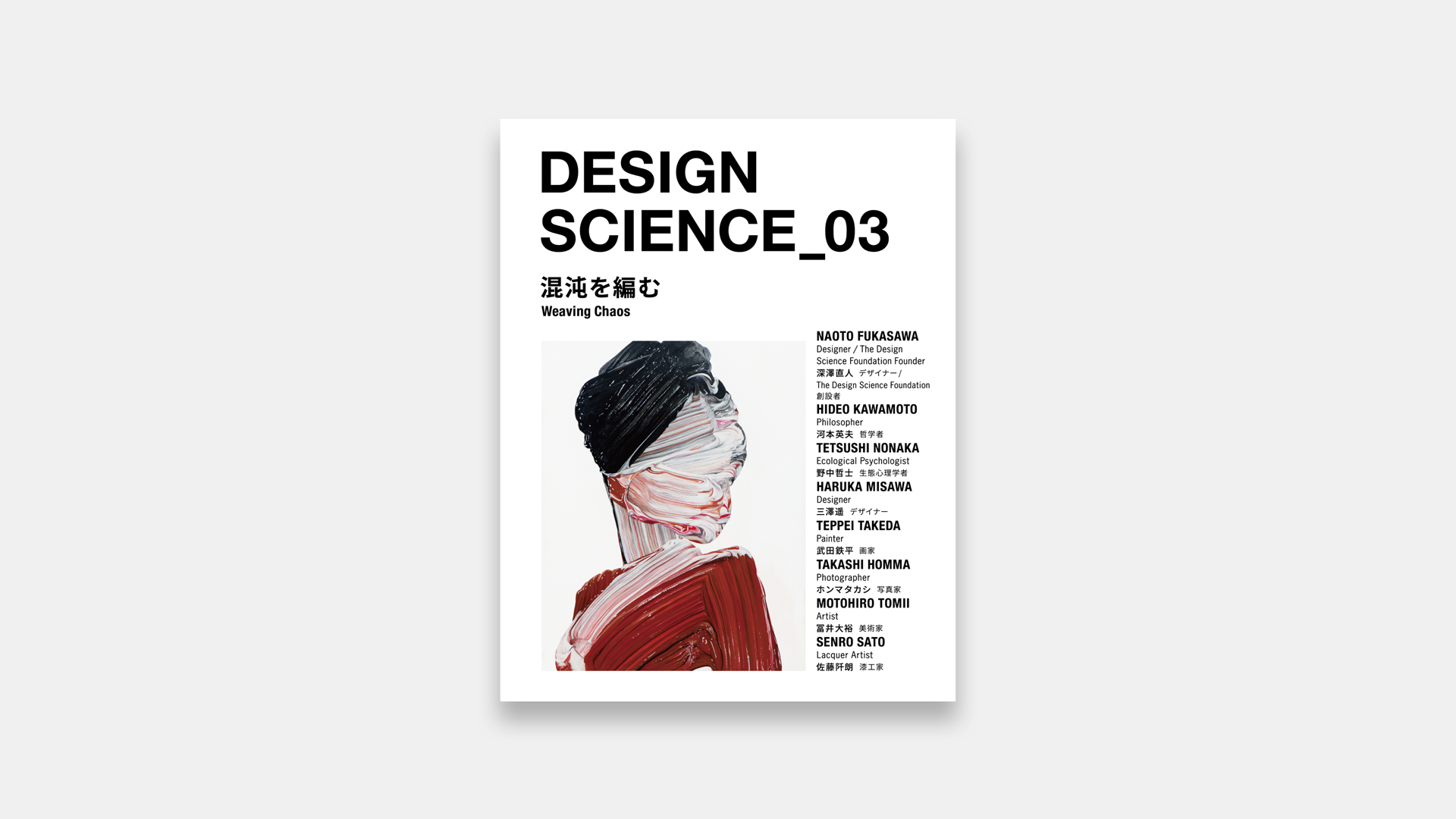
DESIGN SCIENCE_03

“Humans have always survived by finding order within chaos. But now, we find it increasingly difficult to understand what that ‘order’ truly is.” Even grasping reality has become uncertain, and the ability to perceive, such as sensibility and sensitivity, along with the flexibility to respond, is also declining. However, even in our modern era, which tends to favor brain-centered thinking, the body reacts on its own according to its environment without waiting for instructions from the brain. The ambiguous yet definite boundary where the body and environment meet—is it not precisely where the key to “harmony” between humans, objects, and the environment lies? This points toward a way of thinking about “Body × Knowledge at the Boundary” for surviving as human beings.


Naoto Fukasawa
Designer / THE DESIGN SCIENCE FOUNDATION Founder

Fukasawa was born in the Yamanashi Prefecture in 1956. He graduated from Tama Art University, Faculty of Art and Design, in 1980, majoring in Three-Dimensional Design in the Department of Design, Product Design Course. He engaged in design work for seven years, mainly in the Silicon Valley industry, and returned to Japan in 1996. In 2003, the NAOTO FUKASAWA DESIGN was established. He is currently the vice president of Tama Art University, and Director of the Japan Folk Crafts Museum. His ability to capture the essence of objects through design, along with his philosophy and expression, has earned him high acclaim internationally across fields. He has provided design and consulting services to over 70 globally renowned brands and domestic Japanese companies. Additionally, he has recently become involved in natural regional development. Fukasawa is one of the most influential designers in the world. He sits on Ryohin Keikaku’s design advisory board. He has been awarded the Isamu Noguchi Award, the Collab Design Excellence Award 2024, and many others. He established THE DESIGN SCIENCE FOUNDATION in 2022. His publications include Normality (D&Department Project, 2020), AMBIENT: An Exhibition of Lifestyles Designed by Naoto Fukasawa (Gendaikikakusitsu Publishers, 2017), and The Outline of Design (TOTO Publishing, 2005). He co-authored The Ecological Approach to Design: A New Design Textbook (Tokyo Shoseki, 2004) and The Archetype of Design (Rikuyosha, 2002).

Nature may appear chaotic at first glance, yet glimpses of order can be seen in flocks of birds, schools of fish, and even in the arrangement of plant leaves. Humans derive pleasure from this “discovery of order,” which has long supported human survival and learning. Nature is neither simple order nor pure chaos. The “purposiveness without purpose” that Kant described as the essence of beauty lies in the delicate balance between two elements that are not intentionally created yet can only be perceived as such. And there lies the intersection of nature and design. In today’s society, where an overwhelming abundance of choices brings chaos, the philosophy and ideology required of design does not lie in asking “what to choose,” but rather “what not to choose.” It involves establishing the most fitting relationship with the world through space and restraint. The act of not choosing is the wisdom that restores new creation and order. The natural order and fluctuations that emerge from chaos is precisely carrying beauty and emotion. A proposal on the mission of design that illuminates the creativity and survival wisdom needed for humanity to come.


Naoto Fukasawa
Designer / THE DESIGN SCIENCE FOUNDATION Founder

Fukasawa was born in the Yamanashi Prefecture in 1956. He graduated from Tama Art University, Faculty of Art and Design, in 1980, majoring in Three-Dimensional Design in the Department of Design, Product Design Course. He engaged in design work for seven years, mainly in the Silicon Valley industry, and returned to Japan in 1996. In 2003, the NAOTO FUKASAWA DESIGN was established. He is currently the vice president of Tama Art University, and Director of the Japan Folk Crafts Museum. His ability to capture the essence of objects through design, along with his philosophy and expression, has earned him high acclaim internationally across fields. He has provided design and consulting services to over 70 globally renowned brands and domestic Japanese companies. Additionally, he has recently become involved in natural regional development. Fukasawa is one of the most influential designers in the world. He sits on Ryohin Keikaku’s design advisory board. He has been awarded the Isamu Noguchi Award, the Collab Design Excellence Award 2024, and many others. He established THE DESIGN SCIENCE FOUNDATION in 2022. His publications include Normality (D&Department Project, 2020), AMBIENT: An Exhibition of Lifestyles Designed by Naoto Fukasawa (Gendaikikakusitsu Publishers, 2017), and The Outline of Design (TOTO Publishing, 2005). He co-authored The Ecological Approach to Design: A New Design Textbook (Tokyo Shoseki, 2004) and The Archetype of Design (Rikuyosha, 2002).

Before the petals bloom, a cherry tree should already be entirely dyed in cherry blossom pink. Dye artist Fukumi Shimura observed the “process of producing dye with its entire body” in a tree without petals or leaves and succeeded in extracting the dye. This “imaginative intuition” is an artistic intuition that perceives what cannot yet be seen, and it is a form of intellectual intuition. This intuition includes both perceptions, the focused act of knowing, and attention, the capacity to disperse that focus. Distributed attention makes us aware of the world’s diversity and potential for change, the idea that things could always take another form, the latent movement beneath stillness. Goethe’s “archetypal intuition” captures this dynamic quality. Even starfish and squid, which seem to have fundamentally different structures, become adjacent in terms of potential transformation when placed within a phasic coordinate system. The precise bodily control in the long jump and the refinement of pottery also reveal the interlocking between the latent potential of the body and the object. Within that interlocking, the works take on artistic qualities, and at the same time, perception expands and experience itself begins to form.


Hideo Kawamoto
Philosopher

Kawamoto was born in Tottori Prefecture in 1953. He graduated from The University of Tokyo, College of Arts and Sciences. He withdrew from the doctoral program at the Graduate School of Science, University of Tokyo, having completed the required coursework (History and Philosophy of Science), Ph.D. (Academic, University of Tokyo). He served as a professor in the Department of Philosophy, Faculty of Letters at Toyo University and is currently a professor emeritus at Toyo University. His specialties are philosophy, systems theory, and philosophy of science. His publications include Autopoiesis: Third-Generation Systems (Seidosha), Metamorphosis: The Core of Autopoiesis (Seidosha), Resetting Experience: From Theoretical Philosophy to Behavioral Philosophy (Seidosha), System Phenomenolog y: The Forth Domein of Autopoiesis (Shinyosha), How Do Damaged Systems Emerge and Regenerate? The Fif th Domain of Autopoiesis (Shinyosha), The Philosophy of “I” : An Introduction to Autopoiesis (Kadokawa Corporation), Da Vinci System The Coming Métier of Natural Intelligence (Gakugei Miraisha), Practice Problems in Philosophy (Kodansha), and many others. His edited works include The Metamorphosis of Philosophy (Koyo Shobo), The Phenomenological Perspective (Koyo Shobo), iHuman: Organisms, Humans, and Machines in the AI Era (Gakugei Miraisha), Visualizing The Invisible World “World View Atlas”: 10 Chapters to Understanding the “Post-Truth Era” (Gakugei Miraisha), A Sketch of What Is Between “The Emergence” and “The Emergency” : Fieldworks of New Wisdom And Experiences (Gakugei Miraisha). His translated works include Shusaku Arakawa and Madeline Gins, Architectural Body (Shunjusha Publishing), Making Dying Illegal – Architecture Against Death: Original to The 21st Century (Shunjusha Publishing), Arthur C. Danto, Analytical Philosophy of History (Chikumashobo), H. R. Maturana and F. J. Varela, Autopoiesis and Cognition: The Realization of the Living (Chikumashobo) and others.

Animal behavior includes both performatory actions that regulate relationships with the environment and exploratory actions that seek information, such as the antennae of insects. The spider species Octonoba sybotides changes the shape of the center of its web seasonally to detect minute vibrations more sensitively. This is an example of an information-medium design that supports exploratory behavior along with its environment. Weil criticized quantum theory for introducing discontinuity in order to capture a world that produces an infinite variety. Gibson demonstrated that perception is supported by the exploration of continuous optical information. Feynman noted that when many people jump into a swimming pool, waves form on the surface of the water. Imagine an insect that perceives “what is happening now” from those waves. This insect can discern who jumped in, where, and when, based on the characteristics and fluctuations of the waves. This may be what our act of seeing is. What these examples have in common is the continuity of things in the world. Soft-bodied organisms and robots perceive their environments through tension networks. What enables exploration is the continuous field of informational media that envelops both the subject and the environment. This is a proposal from ecological psychology approach to designing information-medium provides rich opportunities for perception.


Tetsushi Nonaka
Ecological Psychologist

Nonaka was born in Tokyo in 1972 and resides in Shioya, Kobe City. After graduating from the Department of Aesthetics, Faculty of Letters, The University of Tokyo, he pursued a career as a musician before completing his doctoral studies at the Graduate School of Interdisciplinary Information Studies, The University of Tokyo. In 2008–2009, he participated in research on the development of tool-use skills at the École des Hautes Études en Sciences Sociales (EHESS) in France. He became an Associate Professor at the Graduate School of Human Development and Environment, Kobe University in 2014, and a Professor at the same institution in 2020. In 2013, he received the 22nd Nakayama Prize Encouragement Award from the Nakayama Foundation for Human Science for his work on the “Biological Science of Movement.” He also received the 14th Japan Society for the Promotion of Science Prize in 2017 for his work in “Research on Flexible Action Control in Body-Environment System.” He was a visiting researcher at the Wyss Institute at Harvard University in 2016–2017 and at the Department of Engineering at the University of Cambridge in 2022. His publications include The Intelligence of the Real Object (Kanekoshobo, 2016) and the co-authored work Body and Affordance (Kanekoshobo, 2018). He is the Director of the International Society for Ecological Psychology.

Recording the “strangeness” of everyday life and accepting its “bizarreness” becomes a gateway to thought and creation. The author recounts an experience at the Round Pond, an artificial pond in London’s Kensington Gardens, as a specific example. The pond, which seemed soft and organic when viewed from the ground, surprised her by revealing a symmetrical composition measuring 200 by 150 meters. When she stands at the edge where straight lines and curves meet, she experiences a strange sensation in which her field of vision and sense of distance become unstable. In that space, the height difference between the water surface and the ground is only about five centimeters, creating a unique sensation where the boundary between the two appears blurred. The birds have grown accustomed to people, and the moment they see food being taken out on the opposite shore, they turn and head directly toward it. They appear chaotic yet possess order, forming a small society of their own. In shallow water, only the white bodies of the swans remain, like floating islands, creating a mysterious scene on the surface. On the lawn, eight birds line up facing the same direction, and she realizes that the essence of strangeness lies in “numbers.” Through the creation of “Clever Doodle on Videos,” she describes the pleasure of improvisation, showing how the unpredictable movements of birds inspire the creation of another scenes, as if the birds were weaving beneath horizontal bars. There is a flow of thought that leads from the question “Why?” born of sudden strangeness to creation. Through this process, she gently unravels the relationship between design and action.


Haruka Misawa
Designer

Haruka Misawa was born in Gunma Prefecture in 1982. She graduated from the Department of Industrial, Interior and Craft Design at Musashino Art University in 2005. Then she worked at the design office nendo before joining the Hara Design Institute at the Nippon Design Center in 2009. In 2014, she established the Misawa Design Institute and initiated its activities. She employed an experimental approach to observe the underlying principles of objects and visualize the unknown possibilities inherent in them. Her major works include “waterscape,” which reconstructed the underwater environment into a new landscape; “Paper Verb,” which explored the possibilities of paper as never before; “WHO ARE WE,” a mobile exhibition kit for the National Museum of Nature and Science, Tokyo; the 25th Yusaku Kamekura Design Award Commemorative Exhibition “Just by”; the Exhibition “Little Haruomi and Mr.Hosono” held at Reifsnider House at the Rikkyo University Campus; and “Hyakuyozu – Unfolding Patterns of A Hundred Wonders,” the new symbol and packaging for the Daimaru Matsuzakaya Department Store. She won the Mainichi Design Award in 2019.

Drawing is much like thinking. With each stroke, he questions the subject, explores its structure and meaning while imagining the parts that cannot be unseen. From the traces of the brush, not only physical marks but also the maker’s personality seeps through. Thought, emotion, and chance blend together in these traces. The artist takes “depicting the act of painting” as his theme, engaging in dialogue with “things within himself that he hadn’t noticed” while observing and analyzing his own creative process. In his creative process, he first decides only on the colors, then makes repeated small-scale tests with paper and brush to introduce elements of chance. He sketches again and again until he intuitively encounters a form that feels right, then enlarges and composes it into the final work. As the brushstrokes accumulate, the more he paints, the more the work stands on its own. Eventually, a moment of dialogue comes when the painting seems to say, “Draw me.” Paintings hold an aura and depth that go beyond materiality, and every stroke shapes their presence. For him, drawing is not an expression of emotion, but rather an effort to gaze inward and give form to something within himself—something he cannot be certain is truly his own. And the answer does not lie in words but within the painting itself. The hand guides the mind, and the painting begins to speak for itself. The painter’s thoughts and methods guided by the act of painting.


Teppei Takeda
Painter

Takeda was born in Yamagata City, Yamagata Prefecture in 1978. He graduated from the Department of Visual Communication Design at the Musashino Art University. He started to work on paintings using the current concept in 2013 and held a solo exhibition titled Painting and Painting, That Painting and that Painting at Kuguru, Yamagata in 2016. In September 2019, he held his first solo exhibition in Tokyo: Paintings of Painting at the Maho Kubota Gallery. In 2024, he held a solo exhibition titled Flowers at the same gallery. His publications include Paintings of Painting (United Vagabonds, 2019) and Flowers (United Vagabonds, 2024). https://www.mahokubota.com/ja/artists/1628/ (From the artist page of the Maho Kubota Gallery).

In the opening of “On Photography,” Susan Sontag wrote that humanity still has not escaped Plato’s cave and continues to revel in illusions of truth. The phenomenon of the camera obscura, where a small hole in a dark room projects an inverted image from outside, was known as early as the pre-Christian era. Painters utilized it for accurate depiction, and it eventually evolved into portable boxes with lenses, becoming the modern camera. However, in bright outdoor settings, people today have lost the experience of gazing at inverted images projected in the darkness. Hokusai’s “Fushiana no Fuji (Fuji through a Knothole)” reflects daily Edo life, when this phenomenon was familiar. Modern architecture, however, has eliminated such phenomenon of light by removing shadows and knotholes. What was the experience of light for the people who painted animals in the caves? Now is the time to return to the “dark cave” and reflect on how people perceived light when neither visual theory nor architectural design existed. Back to the cave, to the experience of primordial light and illusion.


Takashi Honma
Photographer

Honma is a photographer. His recent publications include Portrait of J (Dashwood Books, Session Press); Tokyo Olympia (Nieves); and Thirty-Six Views of Mount Fuji (Mack). From 2023 to 2024, he held a solo exhibition titled Improvisation at the Tokyo Photographic Art Museum. At the 2025 Setouchi Triennale, an exhibition of Songs—The Most Important Things of Refugees, a joint project with UNHCR featuring photographs of refugees–was held at Takamatsu Port.

What is the essence of “creation”? For Tomii, “creating” is an act that begins the moment one “sees it.” The hammer he saw at a home improvement store, a measure, paper folding, sponges, a stepladder, cardboard boxes, or waribashi. What the author “has seen” evokes what “must be done.” These familiar things begin to reveal new aspects under the author’s gaze. The author finds in the hammer’s self-standing form a “standing apart from will”; He views the major scale as a “connecting standard,” or may reinterpret origami as “paper before folding,” or the lightness when stacking sponges, the sentimentality of plugging holes—. The author suggests that “seeing” is already “noticing,” and that the goal of “creating” may be to present that “noticing” without putting it into words. Encountering the “way of being” of things detached from existing functions and contexts, and responding to the temptation of what has been seen, gives rise to what can only be called “artworks.”


Motohiro Tomii
Artist

Tomii was born in Niigata Prefecture in 1973. He graduated from the Fine Art Course (Sculp-ture), Graduate School of Art and Design, Musashino Art University, in 1999. His artistic style evolved from small plaster figurines in his early career to constructing three-dimensional works using a wide variety of ready-made objects such as Super Balls, paper clips, pencils, and hammers. He continues to explore new forms of sculpture by liberating mass-produced objects from their original meanings and functions through simple techniques such as arranging, stacking, bundling, and bending. Alongside projects like “Sculpture of the Day” announced on X (formerly Twitter), he also engages in activities that critically examine existing exhibition spaces and systems. He is a professor at Musashino Art University. He was awarded the Prize For Leading Character 2024 at the DSF Cultivation Awards. Major exhibitions he has participated in include the Yokohama Triennale 2011 (Yokohama Museum of Art/NYK Waterfront Warehouse), MOT Annual 2011 Nearest Faraway (Museum of Contemporary Art Tokyo), Artist File 2015 Next Doors (The National Art Center, Tokyo and National Museum of Modern and Contemporary Art, Korea), Re construction (Nerima Art Museum, 2020), Trio: Modern Art Collections f rom Paris, Tokyo and Osaka (The National Museum of Modern Art, Tokyo and Nakanoshima Museum of Art, Osaka, 2024) and Art of The Real: Transcendent Expression (Tottori Prefectural Museum of Art, 2024). In 2023, he held solos titled Time for Seeing (Niigata City Art Museum) and Sculpture Today (the Tochigi Prefectural Museum of Fine Art). His publications include The Plurality and Lightness (Yumiko Chiba Associates, 2015), Interact (Rondade, 2018), switch point/ Motohiro Tomii’s 10 Years (switch point, 2020), Time for Seeing, and Today’s Sculpture (Suiseisha, 2023). His coedited works include Unknowable Sculpture: Making and Unknowable Sculpture: Viewing (Musashino Art University Press, 2023, 2024).

How was the “eye for seeing things” of the peerless lacquer artist Senro Sato formed? At the root of Mr. Sato’s work lies the craftsmanship he observed in the backstreets of Hachinohe. The movements of the tub maker and tatami maker stirred his young heart, and a respect for the “attitude toward craftsmanship” began to take root. After becoming an apprentice, he was shaped by the strict discipline of the apprenticeship system and the thorough teachings of his master, Yujo Goto. The master taught that “Muda(無駄, waste) is a sacrilege against nature,” demanding an attitude that allowed no muda in materials, in the order of daily life, or even in one’s demeanor. Senro’s encounter with The Japan Folk Crafts Museum began when his work was recognized by Shoji Hamada during a peddling trip. In their conversation, Mr. Fukasawa expressed a strong connection with the aesthetics of “preparation” and “consideration” that characterize the world of artisans. Mr. Fukasawa interprets “Dare (ダレ)” (the slight deformation occurring at corners due to handcrafting, material flow, or heat) as a natural quality that emerges from working with real materials. However, Mr. Sato explains that, “Qualities are not something you create; they emerge as a result.” He reflects further: “Folk art should have been created by the world, not the world created by folk art.” “I want to create something that will lead to a lifestyle where people’s lives become one with nature.” “Making things is, in fact, making the world.” “We must have a clear hope for what they want the world to be like in the future, or good things will not be created.” “We receive natural materials from nature, and the people who use them become happy by using tools. If we do not reach such a state, manufacturing will not lead to good products.” Materials and people, craftsmanship and daily life, rigor and warmth, all unfold within a single thread. A dialogue, where the essence of folk art quietly emerges.


Senro Sato + Naoto Fukasawa

Senro Sato

Lacquer Artist

Born in Hachinohe City, Aomori Prefecture, in 1942. In 1965, guided by Gonroku Matsuda, he became an apprentice to Yujo Goto while studying at the Tama Art University. In 1966, he studied decorative techniques for three years (three sessions) at the Ishikawa Prefecture Traditional Craftsman Training Course. In 1967, he graduated from the Sculpture Department of Tama Art University. In 1972, he established his own studio and became independent. Since then, he has held several solo exhibitions, primarily in Tokyo but throughout Japan. In 1983, he received the Encouragement Award at the Japan Folk Crafts Museum Exhibition (he also received the same award in 1987) . In 1992, he became a judge for The Exhibition of The Japan Folk Crafts Museum, New Works Competition and Exhibition (currently serving). In 1993, he established the lacquerware studio “Sogensha.” The Victoria and Albert Museum acquired his works in 1995. He held a solo exhibition at the “Galerie Fret Jahn” in Munich, Germany. In 1998, he was invited to exhibit and give a lecture at the World Lacquer Art Exchange Exhibition in Taiwan. In 2000, he was invited to exhibit at the National Museum of Modern Arts, Tokyo’s “Viewing Utsuwa” exhibition. He became the Japan Folk Crafts Museum’s Board of Directors in 2006 (current position). From 2011 to 2020, he served as the Managing Director of the Japan Folk Crafts Association and as editor-in-chief of the magazine Mingei, published by that association. From 2021 to 2023, he served as the president of the Tokyo Mingei Association where he is currently an adviser.